



If you use a lower-limb prosthesis, you may eventually hear your prosthetist, physician, therapist, or insurance company refer to you as a K1, K2, K3, or K4 amputee. But what exactly does that mean? Prosthetic K-levels are functional classifications used to describe a person’s current or potential ability to move with a prosthesis.
Medicare uses five functional levels, ranging from K0 through K4, and these classifications can play an important role in determining which prosthetic components are considered medically necessary.
A K-level is not a score of how “good” you are at being an amputee. It is intended to describe your functional abilities, needs, environment, and potential.
Understanding your K-level can help you better understand why certain prosthetic components may be recommended and why documentation of your daily activities matters.
What Does the “K” in K-Level Mean?
In everyday prosthetic care, the functional levels are commonly called K-levels.
They range from:
K0 – No prosthetic ambulation potential
through
K4 – High-impact activity
Medicare uses K0, K1, K2, K3, and K4 modifiers to indicate a beneficiary’s expected functional level. Certain prosthetic knees, feet, ankles, and other components have coverage requirements related to these functional classifications.
The important word here is functional.
Your K-level is not determined simply by your age, amputation level, job title, or whether you consider yourself athletic.
The evaluation looks at what you can reasonably be expected to do with a prosthesis.
K0: No Ability or Potential to Ambulate
K0 is the lowest functional classification.
Medicare defines Level 0 as someone who does not have the ability or potential to safely walk or transfer with a prosthesis and whose mobility or quality of life would not be improved by one.
This may include someone who:
- Is unable to safely use a prosthesis
- Is dependent on a wheelchair for mobility
- Requires substantial assistance for transfers
- Has medical or cognitive limitations that prevent safe prosthetic use
- Would not gain additional mobility from using a prosthesis
Under current Medicare policy, a lower-limb prosthesis is generally not considered reasonable and necessary when a person’s potential functional level is K0.
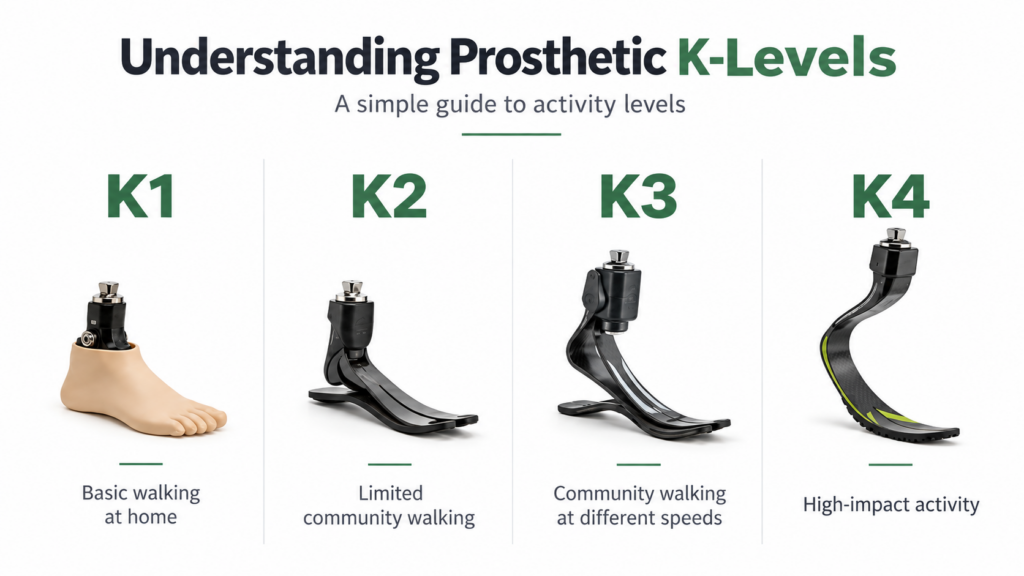
K1: Household Ambulator
A K1 prosthetic user has the ability or potential to use a prosthesis for transfers or walking on level surfaces at a relatively fixed walking speed.
This is generally considered a household ambulator level.
A K1 user may be able to:
- Walk around the home
- Move between rooms
- Perform transfers
- Walk on flat, predictable surfaces
- Use a walker, cane, handrail, or assistance when needed
A person at this level may still rely on a wheelchair for many activities outside the home.
The goal of the prosthesis is often safe and dependable mobility rather than managing complicated terrain or significantly changing walking speeds.
K2: Limited Community Ambulator
K2 represents a person who can move beyond basic household walking and manage some common obstacles encountered in the community.
Medicare describes Level 2 as having the ability or potential to cross low-level environmental barriers, such as curbs, stairs, ramps, or uneven surfaces.
A K2 prosthetic user may be able to:
- Walk inside and outside the home
- Navigate a curb
- Walk on sidewalks or driveways
- Use ramps
- Manage one or two stairs
- Access a vehicle or public transportation
- Walk across some uneven surfaces
Someone at K2 may still use a wheelchair for longer distances.
Another important distinction is walking speed. A K2 user may be able to increase walking speed for short periods, but doing so may require significant effort.
Can a K2 Patient Get a Microprocessor Knee?
This is an important area where prosthetic coverage has changed.
Historically, many advanced prosthetic components were associated primarily with K3 and K4 users.
Under current Medicare policy, certain K2 patients may now qualify for fluid, pneumatic, or electronic/microprocessor-controlled prosthetic knees when specific medical and functional criteria are met. Documentation must show why the technology is appropriate, including how it may improve functional outcomes or activities of daily living and why lower-level knee systems are not appropriate for that individual.
That does not mean every K2 patient automatically qualifies for a microprocessor knee.
It means prosthetic component selection should be based on the individual patient’s medical and functional needs rather than assuming that one component is appropriate for everyone within a particular K-level.
K3: Community Ambulator with Variable Cadence
K3 is one of the most frequently discussed Prosthetic K-levels.
A K3 user is generally an independent community ambulator who can walk at different speeds and negotiate most of the environmental obstacles encountered during everyday life.
That variable cadence is important.
Think about normal life. You probably do not walk exactly the same speed everywhere you go.
You may walk slowly through your house, speed up while crossing a street, walk through a crowded store, climb stairs, walk across grass, and then slow down while talking with someone.
A K3 prosthetic user may be able to:
- Change walking speeds
- Walk across grass or gravel
- Navigate uneven pavement
- Walk through crowded stores or restaurants
- Cross streets within the available crossing time
- Manage several consecutive stairs
- Walk up and down ramps
- Carry something while walking
- Participate in work, exercise, or therapeutic activities that place additional demands on the prosthesis
CMS describes K3 as typical of a community ambulator who can negotiate most environmental barriers and may have vocational, therapeutic, or exercise activities that require prosthetic use beyond basic walking.
Many advanced prosthetic feet and knee systems have traditionally been associated with this functional level.
K4: High-Impact Prosthetic User
K4 is the highest functional classification.
A K4 prosthetic user has the ability or potential to participate in activities that place higher impact, stress, or energy demands on the prosthesis.
Medicare describes this level as typical of the prosthetic demands of a child, active adult, or athlete.
Activities may include:
- Running
- High-impact recreation
- Repetitive stair climbing
- Climbing steep hills
- Physically demanding work
- Certain sports
- More strenuous home or recreational activities
It is important to understand that being active does not automatically make someone a K4. Likewise, you do not necessarily have to be a competitive athlete. The classification considers the actual demands you place, or reasonably expect to place, on your prosthesis.
Your K-Level Is Based on More Than What You Can Do Today
This is one of the most important things patients should understand. K-level determination is not necessarily limited to what you can do right now. Medicare specifically considers a person’s potential functional ability.
The treating practitioner and prosthetist may consider factors including:
- Previous prosthetic experience
- Current physical condition
- Residual limb condition
- Other medical conditions
- Strength and balance
- Rehabilitation potential
- Motivation to walk
- Expected activities
- Current abilities compared with expected future abilities
Medical records should document both the person’s current functional abilities and their expected functional potential when those are different.
That distinction can be particularly important for a new amputee.
Someone receiving their first prosthesis obviously cannot demonstrate everything they may eventually be capable of doing with a properly fitted prosthesis, therapy, practice, and rehabilitation.
The evaluation should consider reasonable potential, not simply take a snapshot of someone’s abilities before rehabilitation has had a chance to occur.
Why Do Prosthetic K-Levels Matter?
Your K-level can affect which prosthetic components an insurance payer considers appropriate or medically necessary.
Different prosthetic feet and knees are designed for different functional demands.
For example, Medicare’s current lower-limb prosthetic policy generally provides coverage for certain foot technologies beginning at different functional levels. Some advanced feet are primarily covered for K3 or higher, while specific circumstances can allow certain higher-level components for qualifying K2 patients.
The same is true for prosthetic knees.
This is why documentation matters.
It is not enough to simply write “K3” in someone’s chart. The medical record needs to support the functional classification and the need for the particular prosthetic technology being requested. CMS specifically requires information supporting the K-level to be maintained in the medical record.
Why You Should Tell Your Prosthetist What You Actually Do
When your prosthetist asks about your daily activities, they are not making small talk.
Those questions matter.
Be specific.
Instead of saying: “I’m pretty active.”
Explain what that actually means.
Maybe you:
- Work on your feet all day
- Walk through large parking lots
- Take care of young children
- Use stairs throughout the day
- Work in construction
- Walk across grass or uneven property
- Exercise at a gym
- Coach sports
- Garden
- Hike
- Golf
- Travel frequently
- Need to move quickly at work
- Walk long distances in the community
Those details help paint a much more accurate picture of what you expect your prosthesis to do.
The prosthetic component that works well for someone who primarily walks around the house may not be appropriate for someone who spends eight hours a day walking around a job site.
Your K-Level Does Not Define You
Prosthetic K-levels are useful because they help describe functional needs and guide prosthetic coverage.
But they are still classifications.
They do not define what someone is capable of accomplishing in life.
Two K3 amputees may live completely different lifestyles. Two K2 amputees may have very different medical needs. Someone’s abilities may also change significantly throughout rehabilitation.
The important thing is that your prosthetic care is based on you, not just a number written in your medical record.
At Leimkuehler Orthotic-Prosthetic Center, we evaluate each patient’s individual needs, abilities, goals, home environment, work requirements, and lifestyle when developing a prosthetic treatment plan.
If you have questions about your K-level, your prosthetic components, or why a particular component has been recommended, ask your prosthetist.
You should understand the technology you are being asked to walk on every day.
The goal isn’t to fit a K-level. The goal is to fit the person.