



When your baby is referred for a cranial helmet evaluation, one of the first things you may hear is: “We’re going to scan your baby’s head.” For a parent, the words cranial helmet scan can sound a lot more intimidating than the actual process.
Is it like an X-ray? Will my baby have to stay completely still? Does it hurt? How long does it take? Do they have to be sedated?
The good news is that a modern cranial scan is usually one of the easiest parts of the entire cranial helmet process.
At Leimkuehler Orthotic-Prosthetic Center, we use scanning technology including the STARscanner and SmartSoc to collect precise three-dimensional information about an infant’s head shape. The STARscanner can capture the necessary 3D head-shape data in less than two seconds. It is non-invasive and does not expose the baby to radiation.
No needles. No anesthesia. No X-rays. And no complicated procedure.
Here is what parents can expect.
Why Does My Baby Need a Cranial Scan?
Every baby’s head is different. Even two babies who both have plagiocephaly may have very different areas of flattening and different degrees of asymmetry. A cranial remolding orthosis therefore needs to be made specifically for the individual baby.
The scan captures the shape of the baby’s head in three dimensions. That digital information can then be used to evaluate the head shape and, when cranial remolding treatment is prescribed, provide the information needed to create the custom orthosis.
The scanning system also allows the orthotist to examine measurements and compare head-shape information during the treatment process. Think of it as creating an extremely detailed digital model of your baby’s head.
Step 1: Your Baby Is Evaluated
Before anyone starts scanning, the cranial evaluation begins with the baby. The practitioner will look at the overall shape and symmetry of the head and review the reason your child was referred.
At Leimkuehler, cranial evaluations are performed by pediatric certified and licensed orthotic practitioners. Measurements are taken and either a STARscan or SmartSoc scan may be performed to help document the severity of the head-shape difference.
Parents should also be prepared to discuss things such as:
- When the flattening was first noticed
- Whether it seems to be improving or worsening
- Whether your baby prefers looking toward one side
- Whether torticollis has been diagnosed
- Whether your baby is receiving physical therapy
- What repositioning has already been attempted
- Your baby’s age and developmental progress
This gives the practitioner important context for what is being seen during the evaluation.
Step 2: We Look at the Head Shape
Before getting caught up in numbers, we look at the baby’s head. Depending on the condition, a baby may have:
- Plagiocephaly, with more flattening on one side
- Brachycephaly, with broader flattening across the back
- Dolichocephaly or scaphocephaly-type positioning, where the head is proportionally longer and narrower
STARband cranial orthoses are designed for deformational head shapes including plagiocephaly, brachycephaly, and dolichocephaly. The scan then gives us objective information that complements what we can see visually.
Step 3: Your Baby Is Prepared for the Scan
One thing the scanner needs is a clear representation of the baby’s skull shape. Hair can interfere with that. Depending on the scanning system being used, a lightweight stocking or scanning cap may be placed over the baby’s head so the hair is compressed and the scanner can more accurately capture the underlying head shape.
Don’t worry. Nobody is giving your baby a haircut. And the cap generally makes babies look mildly ridiculous for a few minutes, which is often one of the more entertaining parts of the appointment.
The important part is getting the hair out of the equation so we are measuring the shape of the head, not the hairstyle.
Step 4: Your Baby Is Positioned in the STARscanner
When the STARscanner is used, the baby is positioned so the scanner can collect information around the head. Parents are sometimes concerned that their baby will have to remain perfectly still for an extended period. Fortunately, the scan itself is extremely fast.
The STARscanner captures a three-dimensional image of the infant’s head in less than two seconds. That speed is a major advantage when your patient happens to be an infant who has absolutely no interest in cooperating with a medical appointment.
We may spend more time getting your baby positioned properly than actually taking the scan.
Step 5: The Scan Is Taken
This is the part parents are usually expecting to be complicated. It isn’t. Once your baby is positioned correctly, the STARscanner captures the head-shape information using eye-safe Class 1 laser technology. The system is FDA-cleared, non-invasive, and does not use radiation.
Leimkuehler’s cranial information also notes that the STARscanner and SmartSoc systems do not require protective eyewear for the infant. There is no contact with the skull from the scanning system itself. There is no injection. There is no sedation. There is no radiation exposure. And there is certainly no reason for your baby to know that something medically sophisticated just happened.
To them, it was basically: Sit here for a second while the adults stare at a computer.
Does the Cranial Helmet Scan Hurt?
No. The cranial scan is non-invasive.
The scanner is collecting external surface information about the baby’s head shape. It is not pushing on or manipulating the skull.
If a baby cries during the appointment, it is much more likely because they are tired, hungry, annoyed about being positioned, or simply expressing their opinion about the entire situation. Babies remain babies, scanner or no scanner.
Is There Radiation?
No.
This is an important distinction because parents understandably hear the word “scan” and think about medical imaging such as CT scans. The STARscanner uses laser scanning technology and does not expose the baby to ionizing radiation.
The purpose is also different. We are not trying to look inside the baby’s skull or examine the brain. We are measuring the external shape and dimensions of the head.
Step 6: A 3D Image Is Created
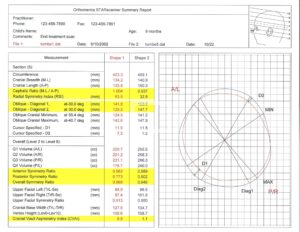
Once the scan is complete, the system produces detailed three-dimensional head-shape data that can be viewed from multiple angles and planes.
Now instead of simply saying: “The left side looks flatter.” we have objective information describing the shape.
The software allows clinicians to examine cross-sectional information and quantify differences in cranial shape. Leimkuehler uses this data to help document the baby’s condition and support clinical decision-making.
This is where technology becomes particularly useful. Parents see a flat spot. The scanner helps us measure it.
Step 7: Measurements Help Determine Severity
The scan can provide measurements that help describe the degree and type of head-shape difference. Depending on the baby’s head shape, the practitioner may discuss measurements related to:
- Overall head width
- Head length
- Diagonal measurements
- Cranial asymmetry
- Head proportions
- Changes from one side to the other
Those measurements help provide a more objective way to describe whether a baby’s deformational head shape is mild, moderate, or more significant.
They also provide a baseline. That baseline becomes useful later because we can compare where the baby started with how the head changes during treatment.
The Scan Doesn’t Automatically Mean Your Baby Needs a Helmet
 This is important. A scan is an evaluation tool. It is not automatically a helmet prescription.
Some infants with abnormal head shape improve through repositioning, physical therapy, increased mobility, and natural growth and may not require cranial remolding treatment. STARband’s own parent information notes that not every infant evaluated for an abnormal head shape ultimately requires a cranial orthosis.
The decision depends on several factors, including:
- The baby’s age
- Severity of the head-shape difference
- Type of deformity
- Growth remaining
- Whether repositioning has helped
- Presence of torticollis
- Medical recommendations
The cranial helmet scan gives the clinical team better information for that discussion.
What If My Baby Has Torticollis?
This is very common in babies with positional head-shape differences.
If your baby strongly prefers looking in one direction or has been diagnosed with torticollis, tell the practitioner. Torticollis can cause a baby to repeatedly rest on the same area of the skull, contributing to plagiocephaly.
Cranial remolding treatment addresses head shape. Physical therapy and appropriate exercises address the neck restriction. For some babies, those treatments happen at the same time.
A helmet does not replace treatment for torticollis.
Step 8: The Results Are Explained to You
 You should not leave the appointment staring at a screen full of measurements wondering what any of them mean. The practitioner can explain:
- What type of head-shape difference is present
- Where the flattening is located
- How significant the asymmetry appears
- What the measurements mean
- Whether continued monitoring is reasonable
- Whether cranial remolding treatment may be recommended
- What happens next
Ask questions. This is your baby. You should understand why a treatment is or is not being recommended.
What Happens If a Cranial Helmet Is Recommended?
If cranial remolding treatment is prescribed, the scan provides the digital shape information needed to create a custom orthosis.
At Leimkuehler, scan data can be electronically provided to Orthomerica for fabrication of the cranial remolding orthosis.
STARband describes its process similarly: precise head-shape measurements collected during the evaluation are used to create an individualized cranial orthosis.
The resulting helmet is not a generic shell pulled off a shelf. It is made around the measurements and shape of your baby’s head.
How Does the Scan Help Make the Helmet?
A cranial remolding helmet does not simply squeeze the baby’s entire head. Instead, its internal shape is designed to create appropriate contact over more prominent areas while providing room for growth where additional expansion is desired.
STARband describes its cranial remolding orthosis as guiding natural head growth by resisting growth in prominent areas while allowing additional growth in flatter regions.
The scan gives the manufacturer an accurate three-dimensional model from which that custom shape can be created. That is one reason precision matters. A few millimeters can be meaningful when we are talking about the head of an infant.
Why Scan Instead of Making a Plaster Mold?
Before digital scanning became widely available, custom cranial orthoses could be created using physical casting techniques. Scanning provides another way to collect the baby’s head shape without the traditional casting process.
Leimkuehler specifically uses STARscanner and SmartSoc technology to eliminate the need for conventional casting when creating custom cranial remolding orthoses.
For parents, that makes the appointment easier. For babies, it means spending considerably less time wondering why adults are making such a production out of their head.
What If My Baby Moves?
Parents sometimes become nervous because their baby is not exactly known for following instructions. Don’t worry. We work with babies. Nobody expects your four-month-old to suddenly develop the discipline of a professional portrait model.
With the STARscanner, the actual data capture happens in less than two seconds, which makes obtaining the scan much easier with infants. If positioning is not ideal or the data is not adequate, the practitioner can determine whether another scan is needed.
The goal is getting good information, not winning a battle with a baby.
How Long Does the Appointment Take?
The scan itself takes only seconds with the STARscanner. The overall appointment takes longer because the practitioner also needs to:
- Evaluate the baby
- Review the history
- Take measurements
- Prepare the baby
- Position the baby
- Review the scan
- Explain the findings
- Answer questions
- Discuss next steps
The fastest part of the appointment may actually be the part parents were most worried about.
What Should My Baby Wear?
The most important thing is that the practitioner can easily evaluate and position the baby’s head and neck. We can give you any specific preparation instructions when scheduling.
It may be a good idea to bring the normal arsenal every parent already travels with:
- Diapers
- Bottle or feeding supplies
- Pacifier
- Favorite toy
- Extra clothing
- Whatever item currently has magical baby-calming powers
A comfortable baby generally makes everything easier.
Should I Feed My Baby Before the Scan?
There generally is not a medical fasting requirement for an external cranial surface scan because the procedure does not involve sedation or anesthesia.
Practically speaking, scheduling around your baby’s usual feeding and nap schedule can sometimes make the appointment easier. A well-rested, fed baby is usually a more enthusiastic participant than a hungry baby who missed a nap. That is not exactly groundbreaking medical science. That is parenting.
What Happens When We Come Back for the Helmet?
If a cranial remolding orthosis is ordered, your family returns for the fitting once the custom helmet is ready. The practitioner checks that the helmet fits properly and explains:
- How to put it on
- How to take it off
- The recommended wearing schedule
- Cleaning
- Skin checks
- What redness is normal
- What problems should prompt a phone call
The helmet will continue to require follow-up as your baby grows.
Leimkuehler currently schedules an initial follow-up after the helmet is provided and subsequent visits according to the baby’s age, severity, and treatment needs so the fit and function can be monitored.
Can My Baby’s Progress Be Scanned Again?
Yes. One of the advantages of digital cranial scanning is the ability to collect objective data over time.
The STARscanner produces quantitative three-dimensional information that can be compared with previous scans to document changes in head shape. That means progress does not have to be judged solely by: “I think it looks rounder.” We can compare measurements and images.
For parents who have spent weeks staring at their baby’s head from every possible angle, having objective data can be reassuring.
The Scan Is Usually the Easy Part
Parents naturally worry whenever their baby is having anything that sounds like a medical procedure. But a cranial helmet scan is not an X-ray, CT scan, or MRI. It is a quick, external measurement of the shape of your baby’s head.
At Leimkuehler Orthotic-Prosthetic Center, our STARscanner and SmartSoc technology allows us to capture detailed three-dimensional information without radiation or traditional cranial casting.
The information helps us evaluate the baby’s head shape, explain what we are seeing to parents, document severity, and create a precisely fitted cranial remolding orthosis when treatment is appropriate.
So if you’ve been referred to us for a cranial helmet scan, don’t let the word scan make you nervous. The technology may be sophisticated. For your baby, the actual scan is over in seconds.