



You notice that your baby always seems to look in the same direction. Then one day you look down from above and realize the back of their head looks a little flatter on one side. Are those two things connected? Very often, yes.
A condition called torticollis can make it difficult or uncomfortable for a baby to turn their head equally in both directions. Because babies spend a significant amount of time lying down during the first months of life, repeatedly resting on the same area of the skull can contribute to positional flattening.
The American Academy of Pediatrics reports a strong association between torticollis and positional skull deformity. That is why treating a baby’s head shape sometimes involves looking farther down than the head. The neck may be an important part of the problem.
What Is Torticollis?
Torticollis describes an abnormal position of the neck in which a baby’s head tends to tilt toward one side while the chin rotates toward the opposite side. One common type in infants is congenital muscular torticollis, often involving tightness or shortening of one of the sternocleidomastoid muscles in the neck.
Parents may notice that their baby:
- Prefers looking in one direction
- Keeps the head tilted
- Has difficulty turning fully toward one side
- Resists being positioned in the opposite direction
- Frequently sleeps with the head facing the same way
- Turns toward one breast more easily during feeding
- Develops flattening on one side of the head
Sometimes the preference is obvious. Other times it is subtle enough that the developing flat spot is the first thing parents notice.
What Is Positional Plagiocephaly?
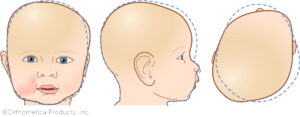 Positional plagiocephaly, sometimes called deformational plagiocephaly or flat head syndrome, occurs when repeated pressure causes one area of a baby’s flexible skull to become flattened.
A baby’s skull is designed to grow rapidly during infancy. The bones have not yet fused together, which allows the skull to expand as the brain grows. That flexibility also means prolonged pressure on one area can influence head shape.
With plagiocephaly, the flattening usually occurs more on one side of the back of the head.
Looking down from above, parents may notice:
- One side of the back of the head looks flatter
- One ear appears slightly farther forward
- One side of the forehead appears more prominent
- The head looks somewhat parallelogram-shaped
- Facial asymmetry may become noticeable
Positional plagiocephaly is different from craniosynostosis, a less common condition in which one or more skull sutures close too early. Craniosynostosis needs specialized medical evaluation and may require surgery, while positional flattening is caused by external molding forces rather than premature fusion of the skull bones.
So How Does Torticollis Cause a Flat Spot?
Imagine lying in bed every night with your head turned toward exactly the same side. Eventually, that same part of your head would be against the mattress over and over again. For an adult, that would not change the shape of the skull. For a young baby with a rapidly growing, flexible skull, repeated pressure can.
A baby with torticollis may naturally return to one preferred head position because turning in the other direction is more difficult. So even if parents reposition the baby’s head, the baby may turn right back.
Over time, the cycle can look like this:
Neck tightness → preferred head position → repeated pressure on one area → increasing flattening.
Children’s Hospital of Philadelphia specifically notes that infants with torticollis may habitually rest in one position and develop plagiocephaly.
The Flat Spot Can Make the Preference Worse
The relationship can sometimes work both ways. Once an area of the skull becomes flatter, that position may become mechanically easier for the baby’s head to rest in. Now the baby already prefers looking toward that side because of the neck restriction, and the shape of the head may further encourage the same resting position.
That is one reason early recognition can be helpful. Instead of waiting until the asymmetry becomes significant, parents and healthcare providers can begin addressing the baby’s positioning and neck movement sooner.
What Causes Torticollis?
There is not always one clear cause.
Congenital muscular torticollis may be apparent at birth or become noticeable shortly afterward. Proposed contributing factors include fetal positioning, limited space before birth, and birth-related factors, although the exact cause can vary.
The important thing for parents is not trying to figure out exactly why it happened on their own. It is recognizing that the baby has a consistent neck preference and having it evaluated.
How Can Parents Spot a Head-Turning Preference?
Spend a little time watching your baby when they are relaxed. Place yourself on one side. Then the other.
Does your baby turn easily toward both sides? When they are lying on their back, does their head naturally return to the same direction every time? During feeding, do they seem much more comfortable facing one direction? During tummy time, is the head consistently tilted?
You might also notice that your baby has difficulty visually tracking a toy through a full range from one side to the other. Torticollis can limit head turning and make activities involving visual tracking, feeding, and play more difficult.
You do not need to diagnose torticollis yourself. You simply need to recognize: “My baby really seems to prefer one side.” That is useful information for your pediatrician.
Why Tummy Time Is So Important
Parents are correctly told that babies should sleep on their backs. That recommendation should not change because of concern about head shape. The American Academy of Pediatrics continues to recommend back sleeping for infant safety. When babies are awake and being supervised, however, tummy time provides an opportunity to get pressure off the back of the head while also helping develop neck, shoulder, and upper-body strength.
That distinction is important: Back for sleep. Tummy time while awake and supervised. Do not place a baby on their stomach to sleep in an attempt to correct a flat spot.
Repositioning Is About More Than Turning the Head in the Crib
Parents sometimes hear “repositioning” and imagine repeatedly turning the baby’s head while they are lying down, but there are many ways to reduce repetitive pressure while the baby is awake.
Depending on your pediatrician’s and therapist’s recommendations, that may include:
- Supervised tummy time
- Holding the baby more frequently
- Changing feeding positions
- Encouraging the baby to look toward the nonpreferred side
- Positioning toys or caregivers to encourage head turning
- Varying how the baby is carried
- Limiting unnecessary time in positioning devices when the baby is awake
The goal is not to create a complicated daily routine. It is simply to give the baby’s head and neck more variety of movement and position.
What About Swings, Car Seats and Bouncers?
Car seats are essential for safe transportation. But outside the car, babies can spend additional time with the back of the head against supportive surfaces in swings, bouncers, loungers, and similar equipment.
For a baby already showing a strong positional preference, additional time resting on the same part of the skull can continue the pressure. That is another reason supervised floor play, holding, and tummy time are valuable when developmentally appropriate.
The solution is not to panic every time the baby’s head touches something. Babies are supposed to lie down. We simply want to avoid the same pressure in the same location for unnecessarily long periods.
How Is Torticollis Treated?
Physical therapy is commonly recommended for infants with congenital muscular torticollis. A pediatric physical therapist can evaluate:
- Neck range of motion
- Head tilt
- Muscle tightness
- Strength
- Head control
- Motor development
- Positional preferences
Parents may also be taught specific stretches, positioning techniques, strengthening activities, and exercises to perform at home. Early identification and treatment are encouraged because delayed intervention can make correction more difficult.
The exercises should be individualized. This is not an area where parents should find a random neck-stretching video online and start experimenting. Your baby’s therapist should show you what is appropriate and how to perform it safely.
Treating the Neck Can Help the Head
This is an especially important concept. If torticollis is contributing to positional plagiocephaly, addressing the neck may help the baby begin spending more time looking in both directions. That reduces the repeated pressure that helped create the flat area in the first place.
CHOP notes that treatment of torticollis can often help improve plagiocephaly because the child becomes more comfortable resting in different positions. This is why looking only at the skull can miss an important part of the treatment.
Does Every Baby With Torticollis Need a Helmet?
No. Torticollis and helmet therapy treat different problems. Physical therapy addresses the baby’s neck movement and muscle imbalance. A cranial remolding orthosis, or helmet, is designed to address head shape.
Some babies with torticollis develop little or no significant skull asymmetry. Others develop positional flattening that improves with therapy, repositioning, and growth. Still others may have moderate or severe asymmetry that persists despite those measures.
The American Academy of Pediatrics states that helmet therapy may be considered for moderate or severe positional skull deformity that has not responded sufficiently to repositioning and other treatment. So the presence of torticollis alone does not mean a baby automatically needs a helmet.
Does a Helmet Fix Torticollis?
No. This distinction is equally important. A cranial remolding helmet addresses the shape of the skull. It does not stretch a tight neck muscle or restore neck range of motion.
If the baby has torticollis, the torticollis still needs to be addressed through the appropriate medical and therapy plan. Otherwise, the baby may continue having the same head-turning preference even while helmet therapy is underway. For some babies, physical therapy and cranial treatment therefore happen at the same time. They are working on two connected problems from two different directions.
When Might Helmet Therapy Be Considered?
Many mild positional skull deformities improve as babies grow, develop better head control, become more mobile, and spend less time resting on the flattened area.
For moderate or severe flattening that persists despite repositioning and therapy, a pediatrician or specialist may recommend evaluation for a cranial remolding orthosis.
AAP parent guidance notes that babies with moderate or severe flattening that has not adequately responded to treatment by around 5 or 6 months may benefit from helmet therapy. Babies referred later may still be treated, although treatment can take longer because skull growth slows as the child gets older.
Every child is different, so the decision should be based on the baby’s age, severity, growth, head measurements, medical history, and response to conservative treatment.
How Does a Cranial Helmet Work?
A cranial remolding orthosis does not squeeze the baby’s head into shape. It is custom fitted to provide appropriate contact in some areas while leaving room for growth in others. As the baby’s skull continues its natural growth, the helmet helps guide that growth toward a more symmetrical shape.
That is why timing matters. Helmet therapy relies on the growth the baby is already doing. We are not forcing the skull somewhere. We are guiding growth.
What If My Baby Has Brachycephaly Instead?
Not every flat head is plagiocephaly. With brachycephaly, flattening occurs more broadly across the back of the head, making the head appear wider and shorter from front to back. Some babies have a combination of brachycephaly and plagiocephaly.
Torticollis is particularly associated with asymmetric positional preference, which often produces plagiocephaly, but each baby’s head shape should be individually evaluated. Parents do not need to figure out which terminology applies by staring at Google images at midnight. A pediatrician or cranial specialist can evaluate the shape and explain what they are seeing.
Could an Uneven Head Shape Be Something Other Than Positioning?
Yes. This is why a medical evaluation matters. Most infant head-shape concerns are positional, but craniosynostosis needs to be distinguished from deformational plagiocephaly.
With craniosynostosis, one or more skull sutures fuse prematurely. That changes how the skull can grow and may require surgical treatment. Positional plagiocephaly does not involve premature fusion of the skull sutures.
If the diagnosis is uncertain, the pediatrician may refer the baby to an appropriate craniofacial, neurosurgical, or other specialist for further evaluation.
Do not assume every unusual head shape is simply from sleeping position. But do not assume a flat spot means something is seriously wrong either. Have it evaluated.
Does Positional Plagiocephaly Hurt the Brain?
Positional plagiocephaly itself is a skull-shape condition and does not restrict brain growth in the way craniosynostosis potentially can. The American Academy of Pediatrics describes positional skull deformity as a cosmetic head-shape issue rather than a condition that damages the baby’s brain. That can be reassuring for parents.
At the same time, torticollis deserves treatment because restricted neck motion and poor head control can affect the way the baby moves and develops. So the goal is not to frighten parents. It is to address both issues appropriately.
Earlier Recognition Gives You More Options
Parents often ask: “Did I wait too long?” The better approach is not to wait for the flat spot to become dramatic before mentioning it. If you notice at two or three months that your baby strongly prefers one side, bring it up. If you notice flattening, mention that too.
Early evaluation gives the care team more time to use:
- Repositioning
- Tummy time
- Physical therapy
- Home exercises
- Monitoring
- Cranial helmet therapy when appropriate
AAP guidance emphasizes early intervention for positional skull deformity and torticollis because younger infants still have substantial growth ahead of them.
Parents Shouldn’t Blame Themselves
A positional head deformity does not mean a parent did something wrong. Babies develop preferences. Some are born with torticollis. Some spend time in the NICU. Some have less room before birth. Some simply seem determined from day one that the entire world exists on the right side of the room.
What matters is recognizing the problem and doing something about it.
What Should You Tell Your Pediatrician?
Be specific. Instead of simply saying: “His head looks funny.” you can say:
“He almost always looks to the right.”
“She doesn’t turn left as far as she turns right.”
“The back-left side of his head is getting flatter.”
“Her head is tilted even when we’re holding her upright.”
“She fights us whenever we try to position her toward the other side.”
Those observations can help your pediatrician understand what is happening.
What Happens During a Cranial Evaluation?
If your baby is referred for evaluation of positional head shape, the provider will examine the overall symmetry and growth pattern of the skull. Depending on the practice and treatment process, measurements or digital scanning may be used to quantify the baby’s head shape and track changes over time. Those measurements help determine whether the asymmetry is mild, moderate, or more significant and whether continued monitoring or cranial remolding treatment may be appropriate.
The evaluation is also an opportunity for parents to ask questions.
You should understand:
- What type of head-shape difference your baby has
- How significant it is
- Whether torticollis may be contributing
- Whether physical therapy is recommended
- What can be done at home
- When the baby should be reevaluated
- Whether helmet therapy may be appropriate
Treat the Baby, Not Just the Flat Spot
A baby’s head shape does not exist separately from the rest of their development. If a baby has positional plagiocephaly and torticollis, both deserve attention. The helmet can address head shape. Physical therapy can address the neck. Repositioning and tummy time can encourage movement and reduce repeated pressure. And the baby’s natural growth helps all of those efforts along.
At Leimkuehler Orthotic-Prosthetic Center, we work with families whose babies have been referred for cranial remolding treatment. Our goal is to help parents understand their baby’s head shape, answer questions about helmet therapy, and provide a custom cranial orthosis when it is medically appropriate.
If you notice that your baby consistently looks in one direction, has difficulty turning the head equally both ways, or is developing a flat area on the head, talk with your pediatrician. Sometimes the flat spot is the first thing you see, but the neck may be telling you why it’s happening.