



When many people hear the word brace, they picture one basic job: Keep something from moving. That makes sense. If you injure an ankle, you brace it. If a knee is unstable, you brace it. If a joint needs protection, you keep it still. But modern custom orthotic bracing can be much more sophisticated than simply locking a joint in place.
Depending on the person’s diagnosis and functional needs, an orthosis may be designed to:
- Limit certain movements
- Allow other movements
- Guide a joint through a particular range
- Improve alignment
- Assist weak muscles
- Stabilize an unstable joint
- Influence another joint farther up the leg
- Redistribute pressure
- Protect sensitive skin or tissue
- Accommodate a deformity
- Improve standing or walking
- Help a person use the strength they still have more effectively
Research on ankle-foot and knee-ankle-foot orthoses demonstrates that changing an orthosis’s stiffness, alignment, resistance, or available joint motion can significantly change how the ankle, knee, and rest of the limb behave during walking.
So while some braces absolutely are intended to immobilize an area, good orthotic treatment often involves a much more important question: What movement does this person need help controlling, and what movement should we preserve?
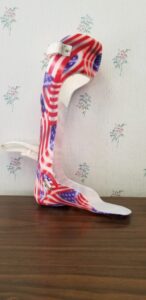 What Is an Orthosis?
An orthosis is an external device used to support, position, protect, or influence part of the body. You may hear names such as:
AFO – ankle-foot orthosis
KAFO – knee-ankle-foot orthosis
KO – knee orthosis
FO – foot orthosis
There are also spinal, upper-extremity, and other specialized orthoses.
Some orthoses are prefabricated and available in standard sizes. Others are custom fabricated around the individual’s anatomy. But regardless of what the device is called, the important part is not simply where the brace goes. It is what the brace is trying to accomplish.
Sometimes Immobilization Is Exactly What We Want
There are certainly situations where limiting movement is the primary goal. An injured or unstable area may need protection. A joint may be moving in a direction that is unsafe or damaging. Someone may lack the muscular strength necessary to control the joint.
In those situations, a more rigid orthosis may provide valuable stability. But even then, orthotic design is rarely as simple as: “Make it as stiff as possible.” The amount of motion allowed can change the person’s entire walking pattern.
Research involving people using KAFOs after stroke has shown that altering available ankle movement changes loading patterns and muscle activity during walking. That means restricting movement can be helpful.
Restricting too much movement can sometimes create a different problem.
Good Bracing Is About Controlling the Right Motion
Think about an ankle that is weak. Maybe the person’s foot drops downward while they walk. They need help controlling that downward motion. But perhaps they still have useful movement in the opposite direction. Should the orthosis eliminate all ankle movement? Maybe. Maybe not.
An articulated AFO can be designed to provide resistance in one direction while allowing more movement in another. Research has demonstrated that adjusting plantarflexion resistance, dorsiflexion resistance, and alignment can change ankle and knee mechanics during walking after stroke.
That is very different from simply putting the ankle in a plastic box.
The orthotist is trying to determine:
What do we want to stop?
What do we want to assist?
What do we want to leave alone?
Those decisions determine how the brace should be designed.
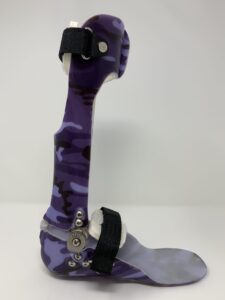 The Ankle, Knee, and Hip Don’t Work Independently
One of the most important concepts in lower-limb orthotics is that joints are connected.
Change what happens at the ankle and you can change what happens at the knee. Change the knee and the person may compensate at the hip. Change alignment underneath the foot and the forces traveling through the rest of the leg can change.
Research has demonstrated this directly. Different AFO ankle positions have been shown to change knee mechanics and loading during walking after stroke. This is why an orthotist should watch the person walk, not simply examine the joint while they are sitting on an exam table.
The problem may be visible at the knee. But the solution may involve the ankle.
A Brace Can Influence a Joint It Doesn’t Even Cross
This surprises many patients. An AFO stops below the knee. Yet an AFO can influence knee position. How? Through the way forces move from the floor through the foot, ankle, and lower leg.
If the orthosis changes the position of the ankle or how easily the lower leg progresses over the foot, it changes the mechanical demands at the knee.
Research on AFO orientation has demonstrated measurable changes in knee flexion and knee moments when ankle alignment is changed. That is why someone with a knee problem does not automatically need a brace extending above the knee.
Sometimes controlling the ankle appropriately provides the influence the knee needs. Other times it does not. The evaluation determines the difference.
Orthoses Can Assist Weak Muscles
Another purpose of custom orthotic bracing is helping compensate for weakness.
Consider foot drop. The muscles that normally lift the foot may not be strong enough to consistently clear the toes during walking. An AFO can help maintain the foot in a position that improves clearance. But a brace can sometimes do more than simply hold the foot up.
Certain designs flex during one part of the step and return energy during another. Other designs provide progressively increasing resistance. Some contain joints, springs, or mechanical systems designed to influence movement.
Studies of articulated AFOs show that carefully controlling resistance can produce measurable changes in lower-limb gait mechanics. The orthosis is therefore acting partly as a mechanical substitute for muscular control the person may not currently have.
Custom Orthotic Bracing Can Provide Stability Without Locking Everything
Suppose someone has significant knee weakness. A traditional KAFO may hold the knee fully extended during walking to prevent it from buckling. That can provide excellent stability.
But walking with a completely locked knee also changes the way the person has to advance the leg.
More advanced orthotic systems may allow controlled knee flexion during appropriate portions of walking while still providing support when the leg is accepting body weight.
Biomechanical research comparing conventional KAFOs with microprocessor-controlled orthotic systems has demonstrated that controlled knee motion under load can change functional movement compared with traditional locked systems.
Again, the goal is not necessarily: Maximum restriction. It is: Appropriate stability with as much useful movement as the person can safely control.
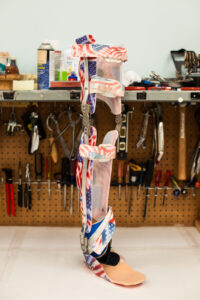 Orthotic Alignment Matters
Two braces can use nearly identical materials and still behave very differently because of alignment. Where the foot sits. The angle of the ankle. The position of the mechanical joints. The relationship between the brace and the shoe. All of these can affect function.
One experimental study showed that simply changing AFO ankle orientation affected heel loading and knee mechanics during walking after stroke. Other research has demonstrated that heel height and footplate stiffness alter lower-limb alignment and joint mechanics when walking in rigid AFOs.
So an orthosis is not simply: “Plastic molded around a leg.” Geometry matters.
The Shoe Is Part of the Orthotic System
Patients sometimes think the brace is doing all the work and the shoe is just there to cover it. That is not always true. With many lower-limb orthoses, the AFO and footwear function together as a system.
Heel height changes the orientation of the orthosis relative to the ground. Sole stiffness changes how the person rolls over the foot. Shoe depth and width affect fit. The sole can influence stability.
Research involving rigid AFOs has demonstrated that altering heel height changes lower-leg orientation and joint mechanics. That is why your orthotist may care a lot more about your shoes than you expected.
Bring the shoes you normally wear to your appointment. Changing from a flat athletic shoe to a significantly different heel can sometimes change how the whole system performs.
Custom Orthotic Bracing Can Redistribute Pressure
Movement control is only one job. Orthotic devices can also be designed to change where pressure occurs. This is particularly important when a specific area of the foot is experiencing excessive loading.
Instead of simply adding a soft cushion directly underneath a painful spot, the goal may be to redistribute load across a larger area or shift pressure away from a vulnerable location.
Research involving custom foot orthoses has demonstrated measurable reductions in plantar pressure compared with sham devices in certain patient populations. Research evaluating metatarsal pads has similarly shown that both design and placement can significantly alter forefoot pressure.
That tells us something important: Where an orthotic feature is placed can matter just as much as what material it is made from.
More Cushioning Is Not Always the Answer
When something hurts, the natural instinct is: Put something soft underneath it. Sometimes that helps. But orthotic pressure management is more complicated.
Imagine placing a thick cushion underneath one specific point. You may reduce pressure there. Or you may simply raise that area and create more pressure.
Position matters. Shape matters. Material density matters. The rest of the foot matters.
Controlled studies of metatarsal pads have shown that changing pad location changes how effectively plantar pressure is reduced. So if your brace is causing pressure, do not automatically start stuffing foam into it at home. You may solve one problem and create another.
Protecting Skin and Tissue Can Be a Major Goal
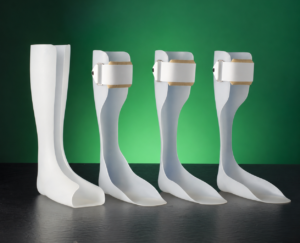 Some patients wear orthoses partly because certain areas of their body need protection from excessive pressure, friction, or repeated loading. This can be especially important for people with:
- Neuropathy
- Bony prominences
- Significant deformity
- Previous wounds
- Reduced sensation
- Fragile skin
For those patients, orthotic design may involve creating relief around vulnerable areas while supporting and distributing load elsewhere.
Studies of custom orthotic interventions have demonstrated that altering the interface underneath the foot can significantly change plantar loading. When sensation is limited, that pressure management becomes especially important because the person may not reliably feel that excessive pressure is developing.
Custom Orthotic Bracing Can Accommodate Deformity
Not every orthosis is trying to make the body perfectly straight. Sometimes a deformity can be corrected or partially corrected. Sometimes it cannot. And sometimes forcing a rigid deformity into a supposedly “normal” position would create excessive pressure or pain.
In those cases, the orthosis may be designed to accommodate the person’s existing anatomy instead. That means creating space where necessary while still providing stability and protection.
The question becomes: Can we safely correct this position? or Do we need to support the position the person already has?
Those are very different orthotic goals. The answer depends on the person’s joint flexibility, strength, skin condition, diagnosis, and overall function.
Corrective and Accommodative Bracing Are Different
A corrective orthosis attempts to influence the body’s position toward a desired alignment.
An accommodative orthosis works around an existing position or deformity rather than forcing it somewhere it cannot safely go.
Sometimes a device does both. It may correct one area while accommodating another. That is one of the reasons custom fabrication can be valuable for complex patients.
The orthosis can be shaped around:
- Individual anatomy
- Bony prominences
- Areas of pressure
- Joint range of motion
- Flexible deformities
- Fixed deformities
- Muscle weakness
- Functional goals
There is no reason two patients with the same diagnosis have to receive exactly the same brace.
Custom Orthotic Bracing Can Improve Function Instead of Simply Restricting It
Patients sometimes worry that wearing a brace means losing movement. In some cases, restriction is necessary. But the larger goal is often to gain useful function.
Maybe the ankle moves less but the person trips less. Maybe the knee is more controlled and the person can safely stand. Maybe the brace limits one unwanted movement and allows the person to walk farther.
Research involving people using AFOs has documented reports of increased walking ability, including the ability to walk farther, although users may also experience tradeoffs such as footwear, comfort, stairs, or driving challenges.
A successful brace should be judged by what it allows the person to do, not simply by how much motion it prevents.
Sometimes Stability Creates Confidence
Imagine having a knee that might buckle every time you put weight on it. Or an ankle that frequently rolls.
You probably begin walking differently. You shorten your steps. You rely more heavily on the other leg. You grab furniture. You stare at the floor. You avoid certain places.
Mechanical stability can sometimes help a person trust the limb more.
Custom KAFOs are specifically used in people with significant weakness or instability to provide external support during standing and walking, although individual experience and usability vary substantially.
That does not mean a brace instantly eliminates fear. But giving the body a more stable mechanical system can create a better platform for rehabilitation.
Function Has to Be Evaluated in Real Life
A brace can look fantastic while someone is standing still. That tells us surprisingly little about whether it works.
Can the person:
- Walk?
- Sit?
- Stand from a chair?
- Climb stairs?
- Walk on a ramp?
- Clear their toes?
- Get into a car?
- Wear normal shoes?
- Perform their job?
- Put the brace on independently?
- Tolerate it for the amount of time they need it?
Research into custom KAFO use has shown that everyday usability involves far more than the mechanical performance of the device; comfort, ease of use, and practical daily experience all matter.
A technically perfect brace that sits in the closet is not accomplishing much.
Comfort Is Part of Function of Custom Orthotic Bracing
Sometimes comfort gets treated like a bonus. It isn’t.
An orthosis usually has to make meaningful contact with the body to create control. But there is a difference between purposeful contact and harmful pressure.
A person is much more likely to use an orthosis consistently when it is tolerable during the activities they actually perform. Research examining daily AFO use has documented comfort, footwear, stairs, uneven terrain, and driving as practical factors influencing people’s experience with prescribed orthoses.
That is why patients need to tell their orthotist what happens outside the clinic.
A Custom Brace Still May Need Adjustments
“Custom” does not mean: Made once and never touched again.
Bodies change. Swelling changes. Strength changes. Range of motion changes. Muscle tone changes. Children grow. Activity levels change. The brace itself wears.
Sometimes a custom orthosis needs:
- Strap replacement
- Padding changes
- Pressure relief
- Alignment adjustments
- Joint adjustments
- Changes in resistance
- Repairs
- Replacement
Research with adjustable articulated AFOs demonstrates how changes in resistance and alignment can alter the mechanical effect of the device. Follow-up is therefore part of orthotic treatment, not evidence that something went wrong.
Sometimes the Orthosis Needs to Change as the Patient Improves
This is especially important during rehabilitation.
Suppose a patient initially has very little control of their leg. They may need a substantial amount of support. Months later, therapy and recovery may improve strength and control. The original orthosis might now restrict movement the patient has regained.
Research in people with severe hemiplegia has shown that changing the available ankle motion of a KAFO as physical function improves can influence loading and muscle activity. That is exactly why custom orthotic bracing should be reassessed.
The goal is not to keep someone in the most supportive brace forever. The goal is to provide the appropriate amount of support for where they are now.
More Brace Is Not Automatically Better
If a little support is good, is more support better? Not necessarily.
More rigid material can provide greater control. It can also restrict useful movement.
A brace extending above the knee can provide more direct knee stability. It can also add weight and complexity.
A locked joint can prevent collapse. It can also change walking mechanics.
More technology can provide additional functions. It can also increase maintenance and training requirements.
Studies comparing conventional and more advanced KAFO technologies demonstrate that different mechanical approaches create different functional effects rather than one design being universally appropriate for everyone. Good orthotic treatment is not about putting the biggest brace possible on someone.
Less Brace Is Not Automatically Better Either
Patients understandably prefer smaller and lighter devices. Orthotists generally like giving people as much freedom as safely possible. But an orthosis still has to accomplish the job.
A tiny brace that does not adequately stabilize an unsafe knee is not better simply because it fits under pants. A flexible AFO that cannot control severe ankle instability is not better simply because it is more comfortable. The goal is finding the balance between:
Control and freedom
Stability and mobility
Protection and function
That balance is different for every person.
Custom Doesn’t Simply Mean “Made to Your Measurements”
Custom orthotic care is more than taking measurements and manufacturing a brace in the right size. The real customization is in the clinical decisions.
How stiff should it be? Where should it bend? Where should it not bend? What position should the foot be held in? How should pressure be distributed? Does the knee need direct support? What happens when the person walks faster? What happens on stairs? What shoes will they wear? Can they put it on themselves? What does their job require?
Those questions are what turn a piece of plastic, carbon fiber, metal, or fabric into an actual treatment device.
Your Orthotist Needs to Know What You’re Trying to Do
Do not just tell your orthotist: “I need a brace.” Tell them about your life.
Do you stand all day? Do you walk on uneven ground? Do you climb stairs at work? Do you drive? Do you care for children? Do you exercise? Have you been falling? Does your knee buckle when you’re tired? Do your toes catch only when you walk fast? Does the problem get worse later in the day?
Those details influence orthotic design. The best brace for someone walking between rooms at home may look very different from the best brace for someone spending eight hours on their feet at work.
Watch the Person, Not Just the Diagnosis
Two people can have the same diagnosis and require completely different braces.
One person after a stroke may primarily have foot drop. Another may have significant ankle instability. Another may have knee hyperextension. Another may have a knee that buckles. Another may have all of those issues combined.
Research repeatedly demonstrates that orthotic mechanical characteristics produce different effects on gait depending on how the device is configured and how the individual moves. That is why good orthotic care starts with the person standing in front of us, not merely the diagnosis written on the prescription.
The Goal Isn’t to Freeze the Body
The human body is built to move. When possible, an orthosis should work with that movement.
Sometimes that means stopping harmful motion. Sometimes it means guiding movement. Sometimes it means providing resistance. Sometimes it means assisting weakness. Sometimes it means redistributing pressure. Sometimes it means protecting tissue. And sometimes it means providing enough stability that a person can safely move again.
At Leimkuehler Orthotic-Prosthetic Center, our orthotists evaluate more than the joint being braced. We consider alignment, strength, range of motion, stability, skin condition, gait, footwear, daily activities, and the individual’s goals when developing an orthotic treatment plan.
Because custom orthotic bracing should not simply fit your leg. It should have a purpose. And that purpose is not always to stop you from moving. Often, it is to help you move better.
If you’re ready to move better, contact Leimkuehler Orthotic-Prosthetic Center about custom orthotic bracing.