



Can you get your prosthesis wet? It sounds like a simple question. Unfortunately, the answer is often: It depends. Understanding the difference between waterproof vs. water-resistant prosthetics can help you know what your prosthesis can safely handle around water.
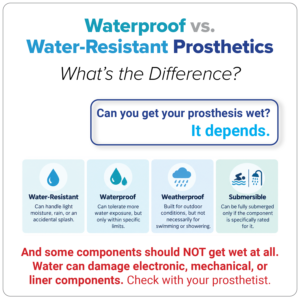
Some prosthetic components can handle rain or an accidental splash. Some can withstand significant exposure to fresh water. Some can be completely submerged under specific conditions. Others are specifically designed for swimming, showering, beaches, or other wet environments. And some components should not get wet at all.
Terms such as water-resistant, waterproof, weatherproof, and submersible can sound interchangeable, but they do not necessarily mean the same thing. That distinction matters.
Modern prosthetic knees, feet, ankles, electronic components, adapters, and other parts can be expensive and highly sophisticated. Assuming that “water-resistant” means “jump in the swimming pool” could turn an otherwise fun afternoon into a very expensive conversation with your prosthetist.
The safest rule is simple: Know exactly what your particular prosthetic components are rated to handle before exposing them to water.
Why Water Exposure Matters With a Prosthesis
A prosthesis can contain many different materials and components, including:
- Carbon fiber
- Aluminum
- Titanium
- Steel hardware
- Bearings
- Hydraulic systems
- Electronics
- Batteries
- Microprocessors
- Sensors
- Charging systems
- Liners and suspension components
- Cosmetic covers
Those parts do not all react to water in the same way. Even if one component is waterproof, another part connected to it may not be. That means you cannot necessarily look at one component and decide the entire prosthesis is safe to take into the water.
A prosthesis is a complete system, and every component in that system has to be considered.
What Does Water-Resistant Mean?
Generally, water-resistant means a component can tolerate a certain amount of exposure to water but is not necessarily designed for unrestricted submersion.
For example, Blatchford currently rates the Orion3 microprocessor knee at IP55. Blatchford describes that level as water-resistant and says it can withstand water jets and weather conditions ranging from light showers to heavy rain. The manufacturer does not describe the Orion3 as a swimming knee.
That is a perfect example of why terminology matters. If you get caught in a rainstorm while wearing a water-resistant knee, you may be fine according to that component’s specifications.
That does not automatically mean you should walk into the deep end of the pool.
 What Does Waterproof Mean?
“Waterproof” generally indicates a greater degree of protection, but even that word requires some explanation. A waterproof component may still have restrictions involving:
- Maximum water depth
- Maximum exposure time
- Fresh water versus salt water
- Chlorinated pool water
- Soap
- Temperature
- Cleaning after exposure
- Required maintenance
For example, Ottobock currently rates the C-Leg 4 at IP68 and describes its electronics as protected during occasional freshwater submersion up to 3 meters for as long as one hour. However, Ottobock also states that the C-Leg is not corrosion-resistant and should not be exposed to salt water, chlorinated water, or solutions such as soapy water.
So even though that component has a high water-protection rating, there are still limits.
“Waterproof” does not mean: Do whatever you want with it in any kind of water forever.
What Is an IP Rating?
You may see prosthetic components labeled with ratings such as:
IP55
IP67
IP68
IP ratings come from the IEC 60529 standard, which classifies the degree of protection an enclosure provides against things such as solid particles and water entering electrical equipment.
For patients, the most important point is not memorizing every possible IP number. It is understanding that different ratings represent different levels and conditions of protection. For example:
An IP55-rated prosthetic knee may be able to withstand substantial splashing or water jets.
An IP67-rated component may allow limited temporary submersion.
An IP68-rated component may allow greater submersion under conditions specified by the manufacturer.
But the number alone does not tell you everything you need to know about how to use the prosthesis. Always check the manufacturer’s specific instructions.
Fresh Water Is Not the Same as Salt Water
This is one of the most important distinctions in waterproof prosthetics. A component may tolerate fresh water and still not be approved for ocean use. Salt water is highly corrosive. That can create problems for metals, bearings, hardware, electronic connections, and other prosthetic components.
For example, Ottobock specifically states that although the current C-Leg 4 offers IP68 freshwater protection, it is not corrosion-resistant and should not be used in salt water.
Other prosthetic components are specifically designed to tolerate salt water. Blatchford, for example, offers prosthetic products specifically engineered for wet environments, including components intended for fresh and saltwater exposure.
That is why asking: “Is my leg waterproof?” is only the beginning.
The next question should be: “Waterproof in what kind of water?”
Pool Water Is Different Too
Swimming pools introduce another issue: chlorine. A component that can safely tolerate freshwater submersion may not necessarily be approved for chlorinated water. Again, the manufacturer’s specifications determine what is safe.
Ottobock specifically warns that its C-Leg 4, despite its IP68 freshwater rating, should not come into contact with chlorinated water.
On the other hand, some components are specifically designed for use in chlorinated water. Ottobock’s Dynion mechanical knee, for example, is currently described by the manufacturer as waterproof and approved for fresh, salt, and chlorinated water when used according to its instructions.
Two prosthetic knees. Both can be described as having significant water protection. Very different rules.
What About Showering?
Showering creates its own set of challenges. People sometimes assume: “If it can handle rain, surely it can handle a shower.” Not necessarily.
A shower can expose the prosthesis to:
- Continuous water
- Soap
- Shampoo
- Warm or hot water
- Slippery surfaces
- Water entering from multiple directions
Some prostheses and components are specifically designed for shower use. For example, Blatchford’s Aqualimb system is designed for showers and wet rooms and is rated for submersion up to a specified depth.
A normal everyday prosthesis may have completely different restrictions.
There is also another issue: Safety. A wet shower floor is slippery for anyone. For someone using a prosthesis, traction, stability, suspension, and the design of the prosthetic foot all become important. A prosthesis being water-safe does not automatically make the environment safe.
Can You Swim With a Prosthesis?
Yes, some amputees swim while wearing prostheses. But the prosthesis needs to be designed and approved for that purpose. Swimming presents very different demands from walking through rain.
The prosthesis may be:
- Completely submerged
- Exposed for an extended period
- Used in chlorinated water
- Used in salt water
- Exposed to sand
- Subjected to water resistance while moving
- Repeatedly wet and dried
A component that tolerates accidental submersion is not automatically intended to function as a swimming prosthesis. Some people use a dedicated water leg instead of their everyday prosthesis. Others use waterproof components as part of their regular prosthetic system. What makes sense depends on the individual person’s activities and equipment.
What Is a Water Leg?
A “water leg” is an informal term commonly used for a prosthesis designed specifically for use around water. Depending on the person’s needs, it might be used for:
- Showering
- Swimming
- Walking around a pool
- Going to the beach
- Boating
- Fishing
- Water parks
- Wet locker rooms
- Other aquatic activities
A water prosthesis may use components selected specifically because they tolerate moisture, submersion, corrosion, or slippery environments.
Some water prostheses are fairly simple. Others use advanced waterproof components. There is no single standard water-leg design. The prosthesis should be built around what the person actually plans to do with it.
Waterproof Does Not Mean Maintenance-Free
Even prosthetic components designed for water exposure may require care afterward. Depending on the component, manufacturer instructions may recommend steps such as:
- Rinsing the prosthesis with fresh water
- Removing salt, sand, chlorine, or dirt
- Drying the component
- Allowing drainage
- Inspecting moving parts
- Following specific maintenance schedules
This is especially important after saltwater exposure. A component being approved for ocean use does not necessarily mean you can walk out of the ocean, throw the prosthesis in your car, and forget about it for three days. Follow the manufacturer’s cleaning and maintenance instructions.
 Sand Can Be Just as Important as Water
The beach gives you a two-for-one special: Water and sand.
Sand can work its way into moving components, cosmetic covers, joints, locks, valves, foot shells, and other areas of a prosthesis. A device may have excellent water protection while still having specific restrictions concerning sand or other debris.
Some IP-rated electronic components also include protection against dust and particles, but again, the exact protection depends on the particular device and rating. Ottobock, for example, describes the current C-Leg 4’s IP68 protection as including protection from dirt, sand, and dust as well as limited freshwater submersion.
Still, if your prosthesis has been exposed to a significant amount of sand, it is worth following the manufacturer’s cleaning instructions or asking your prosthetist what should be done.
Don’t Forget About the Foot Shell
Sometimes people focus entirely on the knee or electronic component. But the prosthetic foot and foot shell matter too. Water, sand, dirt, and debris can collect inside a foot shell.
Different prosthetic feet have different water ratings and maintenance requirements. If your knee is waterproof but your foot is not intended for the same environment, then your prosthesis as a whole may still not be appropriate for that activity.
The same principle applies to:
- Rotators
- Adapters
- Tube clamps
- Electronic ankles
- Chargers
- Batteries
- Cosmetic coverings
One waterproof component does not make every connected component waterproof.
Electronics Have Changed the Conversation
Years ago, one of the easiest rules around prosthetics was: Keep electronics away from water.
Modern prosthetic technology has made that rule much less universal. There are now microprocessor-controlled components offering significant levels of water protection. That is a major improvement for amputees.
Rain should not necessarily mean panic. Accidental splashes do not always mean disaster. And some modern components can tolerate limited submersion. But electronic water resistance still varies dramatically by manufacturer and model.
For example, current Ottobock guidance lists different protection levels for different microprocessor knees: Kenevo is identified as water-resistant, while the C-Leg 4 and Genium offer specified levels of freshwater submersion protection. That is why you should never assume one microprocessor knee has the same water capabilities as another.
What If Your Prosthesis Accidentally Gets Wet?
First, don’t panic. What you should do depends on:
- What component got wet
- How wet it became
- What type of water was involved
- How long it was exposed
- Whether the component is electronic
- The manufacturer’s instructions
A light splash on a water-resistant component is completely different from dropping a non-waterproof electronic knee into a swimming pool.
If the exposure exceeded the manufacturer’s specifications, contact your prosthetist.
Do not assume that because the component still appears to work immediately afterward there cannot be a problem. Water-related damage and corrosion are not always obvious right away.
If You Hear or Feel Something Different Afterwards, Pay Attention
After water exposure, contact your prosthetist if you notice:
- Unusual noises
- Grinding
- Unexpected resistance
- Electronic warnings
- Charging problems
- Changes in knee function
- Changes in ankle movement
- Corrosion
- Loose components
- Problems with suspension
If an electronic prosthetic knee begins behaving unpredictably, that can become a safety issue.
Do not keep using a component normally simply because you hope the problem will disappear.
Talk About Water Before Your Prosthesis Is Built
This is probably the most useful advice in the entire article. Tell your prosthetist before component selection if water is a major part of your life.
Maybe you:
- Own a pool
- Swim regularly
- Live near the lake
- Boat
- Fish
- Kayak
- Go to the beach
- Work outside
- Work around water
- Vacation near the ocean
- Want to shower while wearing a prosthesis
- Frequently get caught in wet or muddy environments
Those activities can influence component selection.
If water exposure matters to you, it should be discussed when designing your prosthesis rather than discovered six months later when you ask whether you can take your new knee into the ocean.
Ask Specific Questions
Instead of simply asking your prosthetist: “Is this waterproof?” Ask:
Can I wear it in the rain?
Can I shower with it?
Can I completely submerge it?
How deep can it go?
For how long?
Can it go in a swimming pool?
Can it go in the ocean?
What about soap?
Do I need to rinse it afterward?
Does every component on my prosthesis have the same rating?
Those questions produce much more useful answers.
Don’t Trust the Word “Waterproof” by Itself
The prosthetic industry has come a long way. Modern users have more water-resistant prosthetics and waterproof component options than ever before. But no amputee should make decisions based on a single marketing word.
Read the specifications. Know the rating. Understand the limitations. Ask your prosthetist. Follow the manufacturer’s instructions.
At Leimkuehler Orthotic-Prosthetic Center, we consider where and how each patient plans to use their prosthesis when recommending components. For someone who spends most of their time indoors, water exposure may not be a major concern. For someone who boats every weekend, works outside, swims, travels frequently, or simply wants to stop worrying every time clouds roll in, it may be an important part of the prosthetic plan.
Your prosthesis should be designed for your life — including the parts of your life that happen around water.